MRED Blog
REinventing MLS
The Cost of Waiting to Buy a Home

The National Association of Realtors (NAR) recently released their July edition of the Housing Affordability Index. The index measures whether or not a typical family earns enough income to qualify for a mortgage loan on a typical home at the national level based on the most recent price and income data.
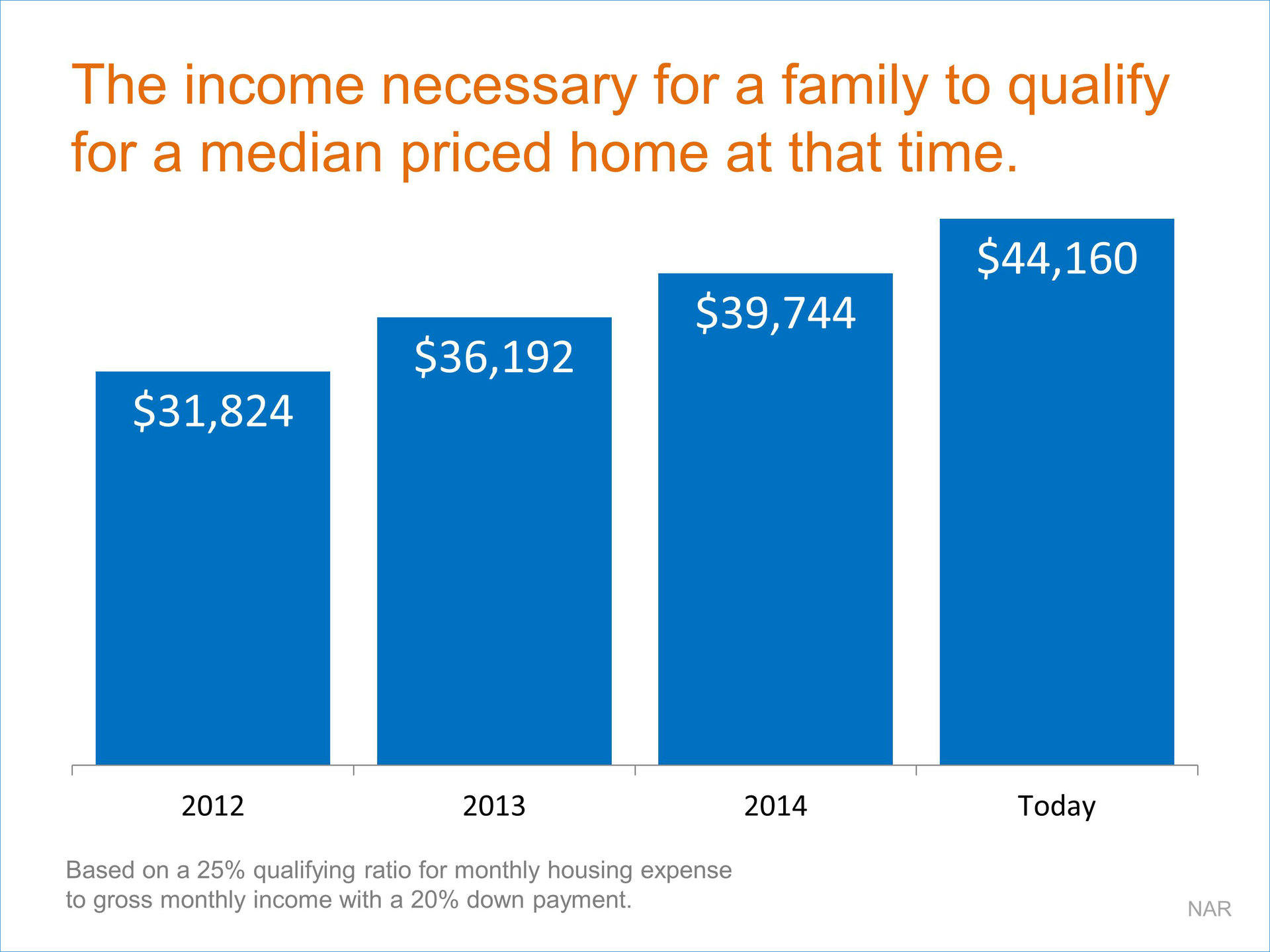
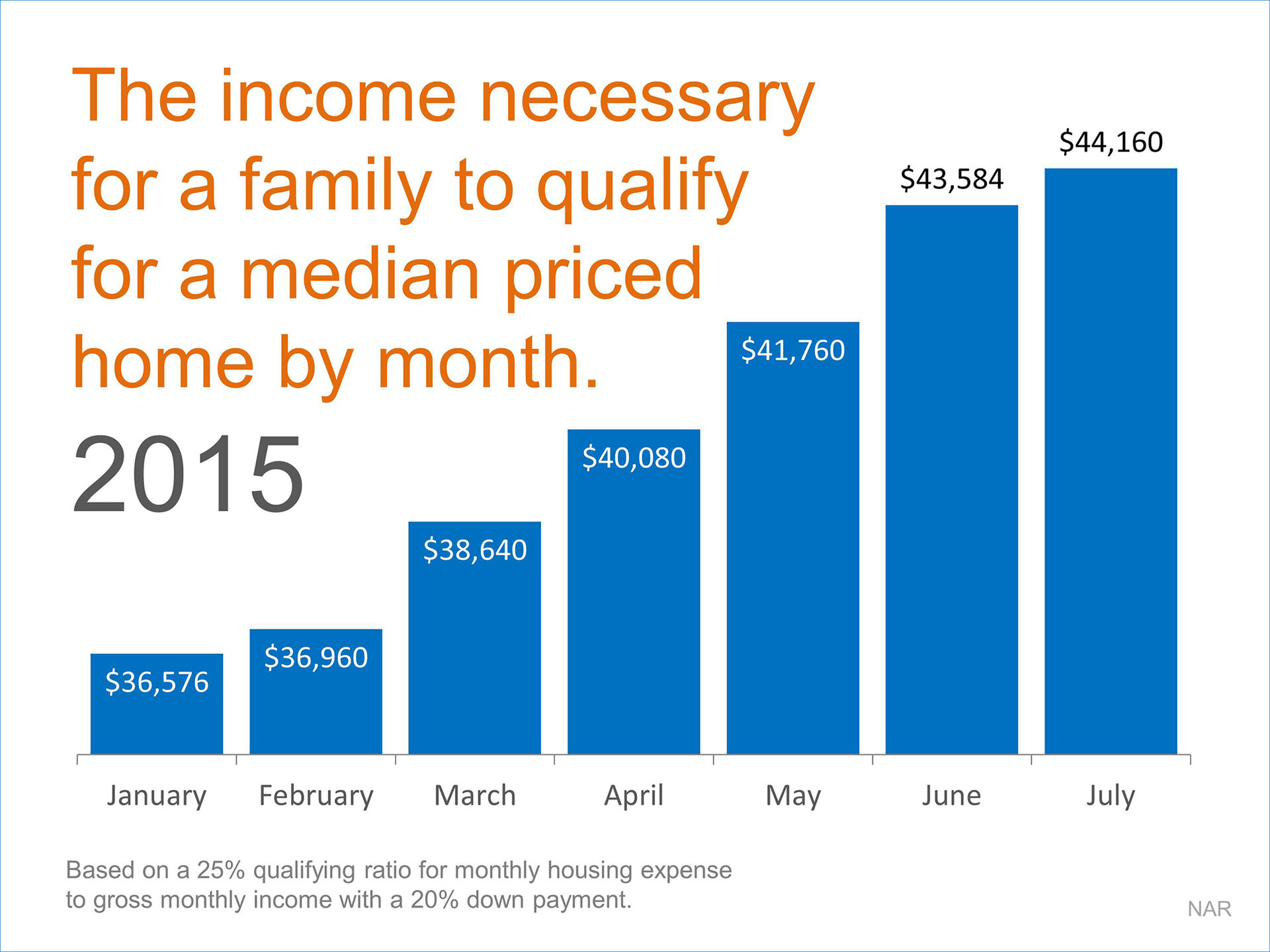
NAR looks at the monthly mortgage payment (principal & interest) which is determined by the median sales price and mortgage interest rate at the time. With that information, NAR calculates the income necessary for a family to qualify for that mortgage amount (based on a 25% qualifying ratio for monthly housing expense to gross monthly income and a 20% down payment).
Here is a graph of the income needed to buy a median priced home in the country over the last several years:
And the income requirement has accelerated even more dramatically this year as prices have risen:
Bottom Line
Some buyers may be waiting to save up a larger down payment. Others may be waiting for a promotion and more money. Just realize that, while you are waiting, the requirements are also changing.
Blog Post via KCM Blog
MRED Director Tapped for RESO Chairmanship
Special Projects/R&D Director Lambrou Latest to take on Leadership Role
 LISLE, ILLINOIS (September 3, 2015) – Midwest Real Estate Data (MRED), Chicagoland’s multiple listing service (MLS), announced that Chris Lambrou, its Director of Special Projects/R&D, has been named the first chair of the newly formed Real Estate Standards Organization (RESO) Internet Tracking Workgroup.
RESO is a group of real estate organizations working together to develop and implement data standards and processes that support innovation, ensure portability, eliminate redundancies and obtain maximum efficiencies for all parties participating in the real estate transaction. RESO’s ultimate goal is a fully automated real estate transaction facilitated by data standards and processes accepted by real estate professionals everywhere.
RESO has formed the Internet Tracking Work Group in response to the significant interest that exists today in big data analysis and developing ways to measure the value of data displayed.
“Tracking data is a key component for any modern day data set,” said Lambrou. “No longer is having the data secure and readily available enough. True analytics that show value are now expected and commonplace in the software industry. A RESO standard on tracking RETS data would be beneficial for all parties involved. I’m extremely excited for the opportunity to be the facilitator of this conversation and look forward to the journey ahead.”
“Today across the nation, brokers and agents advertise listings through hundreds of different outlets,” said Jeremy Crawford, Executive Director of RESO. “Understanding the value proposition of their advertising efforts and the reach of those efforts are critical to their everyday business. The new Internet Tracking workgroup chartered by the RESO Board of Directors will strive to create standards which will allow for brokers and agents to have transparency into the Internet listing activity and even behaviors by consumers so the brokers and agents know where best to focus their efforts and what is truly successful. The listing tracking information will also help technology and advertising companies tailor their products, services, and targeted outreaches to best serve their respective broker and agent customers.”
“We are proud of Chris and the contributions he has made in developing the sourceMLS analytics platform,” said MRED President/Chief Executive Officer Rebecca Jensen. “Tracking product usage amongst our vendors is key. MLSs need to make business decisions with this data, and it will help us compare “apples to apples”. I am very happy RESO is taking full advantage of the knowledge and insight Chris will bring.”
About MRED
Midwest Real Estate Data (MRED) is the real estate data aggregator and distributor providing the Chicagoland multiple listing service (MLS) to more than 40,000 brokers and appraisers and nearly 8,000 offices. MRED serves Chicago and the surrounding “collar” counties and provides property information encompassing northern Illinois, southern Wisconsin and northwest Indiana. MRED delivers over twenty products and services to its customers, complementing connectMLS™, the top-rated MLS system in the country for two years running according to the WAV Group MLS Technology Survey. MRED is the 2013 Inman News Most Innovative MLS/Real Estate Trade Association, and for five consecutive years the MRED Help Desk has been identified as one of the best small business centers in the United States and Canada by BenchmarkPortal. For more information please visit MREDLLC.com.
NAR’S Latest Existing Home Sales Report [Infographic]
![NAR's Latest Existing Home Sales Report [INFOGRAPHIC] | Keeping Current Matters](https://i0.wp.com/www.keepingcurrentmatters.com/wp-content/uploads/2015/08/EHS-20150828-KCM.jpg)
Infographic via KCM Blog
MRED Chicagoland Report for July, 2015
According to the U.S. Census, homeownership is at 63.4 percent for the second quarter of 2015, down 1.3 percent from the second quarter of 2014. This is the lowest rate of homeownership since 1967. To put that in greater context, homeownership peaked at 69.2 percent in 2004, and the 50-year average is 65.3 percent. Although the data may be indicating otherwise on a macro level, mortgage applications have kept REALTORS® busy through summer.
New Listings in Chicagoland were up 4.7 percent for detached homes and 1.3 percent for attached properties. Listings Under Contract increased 20.1 percent for detached homes and 22.5 percent for attached properties.
The Median Sales Price was up 3.1 percent to $230,000 for detached homes and 6.1 percent to $189,950 for attached properties. Months Supply of Inventory decreased 14.8 percent for detached units and 16.2 percent for attached units.
Ever since the Great Recession ended in about June 2009, the market has strengthened to once again become a cornerstone of the national economy. Better lending standards, lower oil prices and higher wages are a few of the catalysts for positive change. Many trends continue to reveal a stable housing market. Federal Reserve Chair, Janet Yellen, has predicted a fine-tuning of monetary policy by the end of the year. It is widely believed that interest rates will go up before the year is over, an indicator that the housing market is ready for such a move.
MRED real estate professionals can log into MREDLLC.com and click on the Statistics tab to get the latest Lender Mediated and Monthly Market Indicators Reports. You can also click on the Local Market Updates choice under the Statistics tab and use our Interactive Market Analytics map for the latest local market metrics.
Any questions? Please contact MRED’s Help Desk at 630-955-2755 or help.desk@MREDLLC.com.
The Top 5 Things to Know about TRID Now
 With TRID’s (TILA-RESPA Integrated Disclosure Rule) effective date of October 3, 2015 approaching, lenders, real estate agents and settlement agents need to be taking stock of their preparedness and communicating among themselves and with consumers about what do expect.
Read the “Top 5” for TRID Compliance by three individuals from organizations recognized as industry leaders who have been dedicated to implementing TRID on time and in compliance.
Article via RIS Media
When is it a Good Time to Rent? Definitely NOT Now!

People often ask whether or not now is a good time to buy a home. No one ever asks when a good time to rent is. However, we want to make certain that everyone understands that today is NOT a good time to rent.
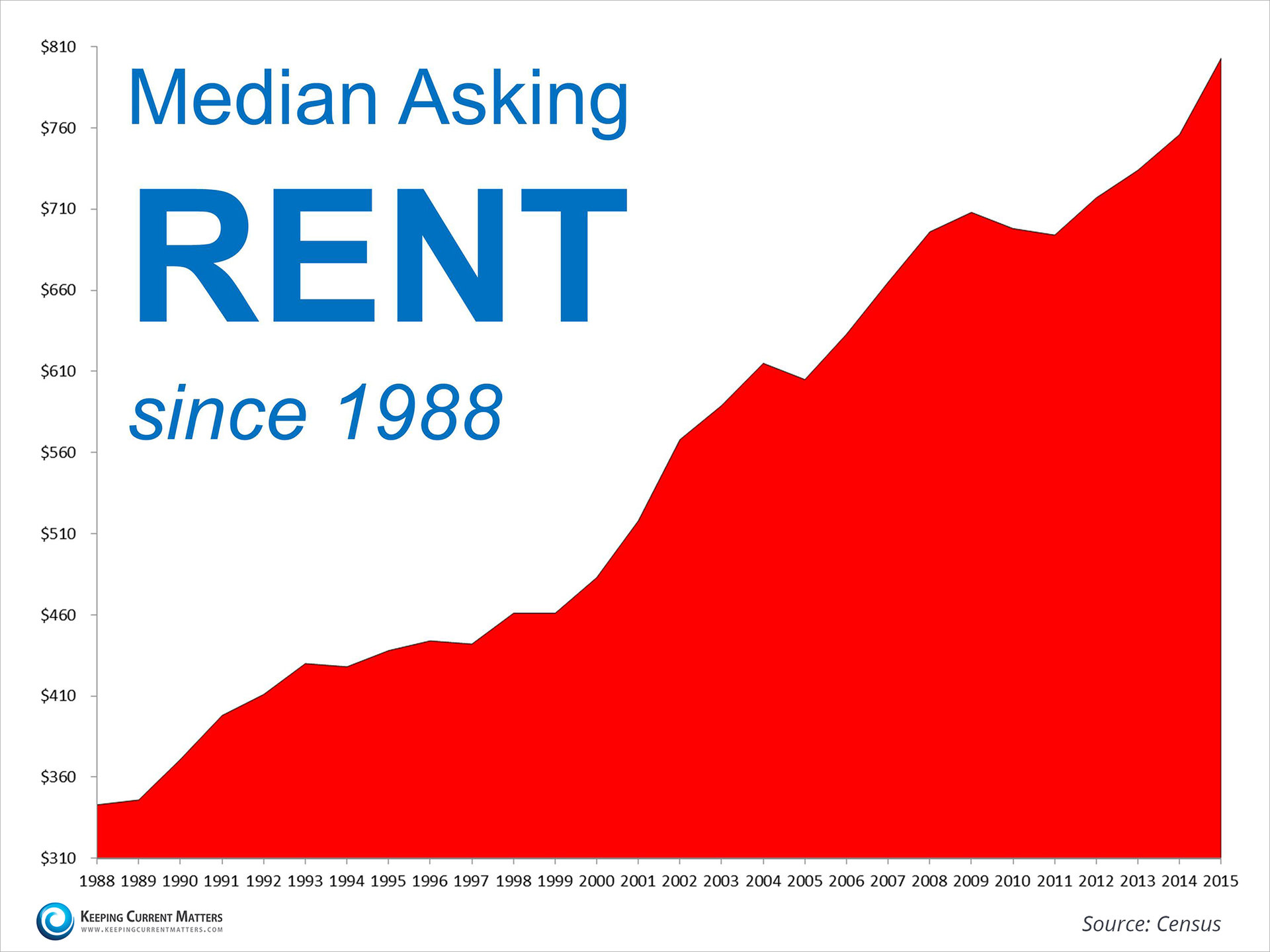
The Census Bureau just released their second quarter median rent numbers. Here is a graph showing rent increases from 1988 until today:
 At the same time, a report by Axiometrics revealed:
“The national apartment market’s annual effective rent growth rate of 5.1% in June 2015 represented a 47-month high, and continued a streak of 5.0%-plus rent growth that is now the longest in at least six years, according to apartment market research. The effective rent growth in June 2014 was 3.7%, putting June 2015’s exceptional performance into perspective.
This is the highest rate since the 5.3% of July 2011. The metric has reached at least 5.0% for five straight months, the longest such streak since Axiometrics started monthly reporting of annual apartment data in April 2009.”
Where will rents be headed in the future?
Stephanie McCleskey, Axiometrics vice president of research, commented on the above report in an article by Real Estate Economy Watch:
“Rent growth is just shy of the post-recession peak, and the June metrics reflect the continued strength of the apartment market. The demand for apartments is still strong, despite the record number of new units being delivered this year. Tight occupancy is why landlords can push rents higher.”
Bottom Line
If you are ready, willing and of course able to buy, now may make sense.
Blog Post via KCM Blog
 MRED Blog